


Working hard but still struggling to make your revenue consistent? You might be closer to your next stage of growth than you think, but getting there requires more than another strategy.
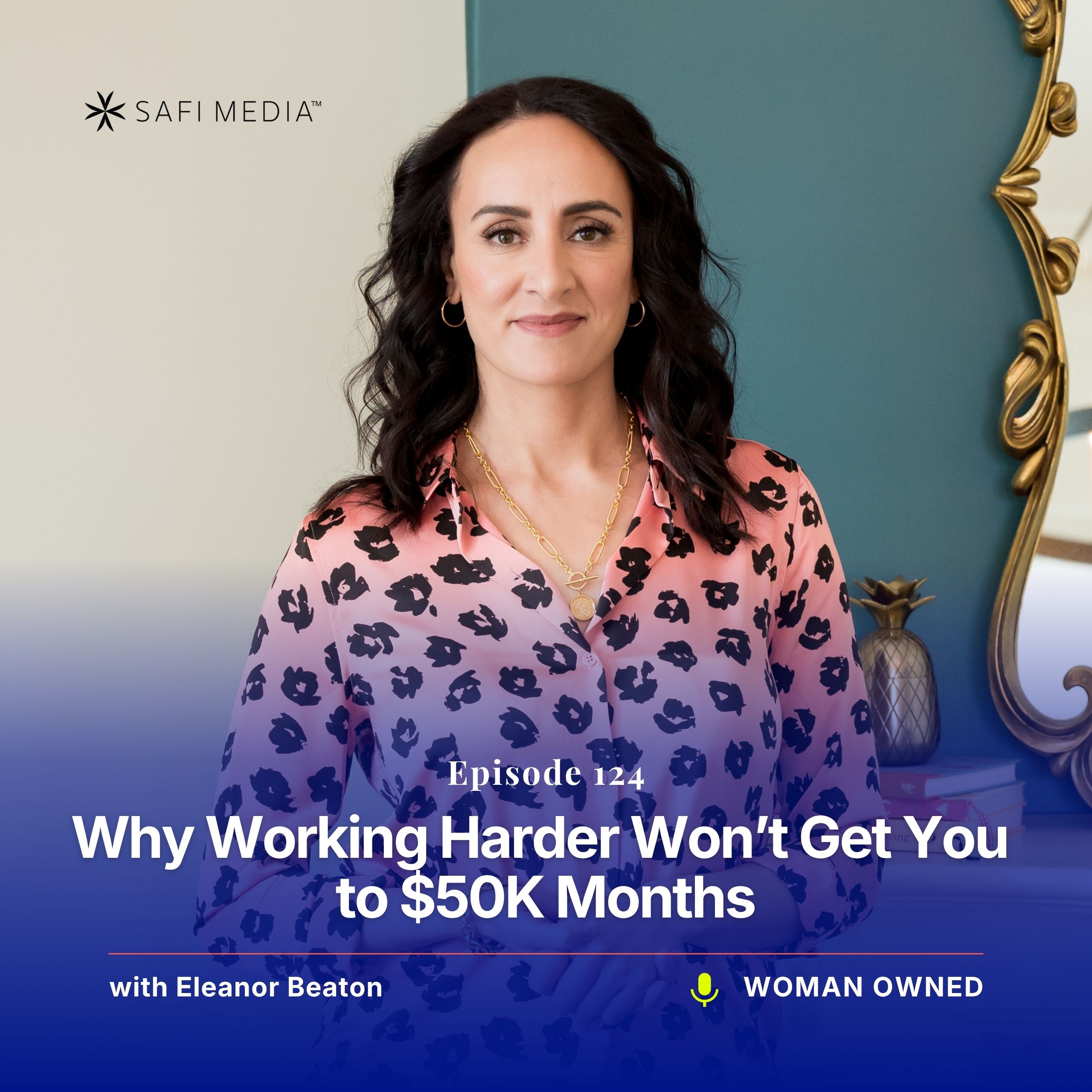
In this replay, Eleanor explores why so many women entrepreneurs get stuck in the messy middle between $15K and $50K months. Drawing on her own experience and the patterns she’s seen in hundreds of women-led businesses, she explains why the transition isn’t simply about doing more, but about changing how you see yourself and your role as a leader.
Listen in this week as Eleanor shares five identity shifts that help entrepreneurs move beyond inconsistent revenue and build more predictable growth. Learn how to approach risk strategically, lead your business rather than simply deliver your expertise, develop a team that owns results, make decisions using data, and build systems that allow your business to grow beyond your personal capacity.
Request a structural read of your business to find out what you can put in place to allow your business to make more income for you here.
Today on Woman Owned:
- Why moving from inconsistent $15K months to predictable $50K months requires fundamental identity shifts, not just better strategies.
- How to move from avoiding risk to making strategic investments that create opportunities for growth.
- Why shifting from expert for hire to strategic CEO changes how you approach pricing, positioning, and business decisions.
- The difference between managing people and leading a team accountable for results.
- How combining data, experience, and intuition helps you make more strategic decisions and create predictable growth.
- Why your business needs systems and leverage rather than relying on your personal capacity to drive revenue.
- How to start making these shifts through strategic investments, dedicated CEO time, clearer team outcomes, and consistent tracking of business metrics.
Resources Mentioned:
-
- The SAFI Diagnostic is a free, 15-minute structured conversation to pinpoint:
-
- 2 or 3 real problems constraining your growth
-
- How much those problems are costing the business on a monthly and annual basis.
-
- Whether SAFI is the right partner to install the fix.
-
- The SAFI Diagnostic is a free, 15-minute structured conversation to pinpoint:
-
- To receive the Woman Owned newsletter, make sure you sign up here!
-
- Organic Influence: Build a Loyal Following and Sell with Ease by Eleanor Beaton
-
- Check out Eleanor’s YouTube channel!
-
- If you want to be a part of our sales growth case study to see what happens when we partner with you to explode your sales pipeline, contact Eleanor here.
-
- Get my free ebook, How To Know When Cutting Back on 1:1 Client Work Makes Sense here.
-
- Request a structural read of your business here.
- If you’re ready to start delegating more effectively, grab The CEO Handoff System: Your 30-Day Quick Start Guide.
FAQ
Podcast Transcript
Hey woman owner. Today's podcast episode is specifically for those of you who are in the $10,000 to $25,000 per month revenue range. It's a very specific growth area for women entrepreneurs, and I wanted to take a very specific episode to walk you through what to expect from this particular stage of growth and also the key things that you need to shift inside you as a leader in order to go from having sort of inconsistent revenue, where maybe you've had a couple of $20,000 months and then you drop back down to $12,000, and then maybe you have a month where you're at $8,000, and then you're back up to $20,000, and you can't figure out the pattern.
Well, I have been there. I remember when I was stuck in that exact same place, and I was working really hard. I felt like I was doing a lot of the right things, but it didn't produce the kind of consistent revenue that I wanted. And I want to really share something quite vulnerable with you. And that is that the shift from inconsistent, like $15,000 per month, revenue level to predictable $50,000 months. So making that leap from like $150,000, $180,000 a year to half a million a year, it wasn't actually about working harder or finding better strategies.
It was actually about five fundamental identity shifts that completely changed how I saw myself as a business owner. The strategies and tactics were super important, but I found it hard to implement them consistently without the identity shifts that I'm going to share with you here, right? So it's like the difference between watching a dancer go through the motions and a dancer truly live that dance. You know, there's a big difference in their energy, in their commit level, and how they show up. And that's the power of shifting your identity.
And here's what's wild. I've now guided hundreds of women through this exact transition, including one of my clients, Megan, who went from feeling like a stressed-out practitioner to running a predictable, profitable business that she actually leads instead of just delivers. So today I'm breaking down the exact five identity shifts that separate women who stay stuck in the feast or famine cycle from those who scale to consistent $50,000 months. Plus, I'll share some specific actions you can take this week to start making these identity shifts real. Let's go.
Welcome to the Woman Owned podcast. I’m Eleanor Beaton and this show is for women who run real businesses and make real decisions. Here, we talk about revenue, leadership, and growth without hype, hustle, or internet nonsense. If you’re building something serious and you want clear thinking you can actually use, you're in the right place.
All right, so let's break this down. This to me is like my number one. And anytime, like I ask myself this anytime I feel like I'm getting stuck in my business or I'm hitting a plateau of any kind, I ask myself, am I taking enough risks? So identity shift number one is moving from risk avoider to strategic risk-taker.
So the old identity is, I need to be financially safe before I can invest in growth. And the new identity is, I invest strategically in my vision even when it feels scary. So, I'll never forget when I decided to host my first live event.
So, I had, you know, gone and attended networking events. I had spoken at networking events. I'd spoken at other people's events. But I was feeling this kind of craving to bring people together in my community to have like an intensive two-and-a-half-day experience. And I really felt like that's what I actually needed. For me at the time, I felt like that's what I needed to launch like a more sort of higher ticket intensive group coaching program. I wanted to create some of that cohort energy, have people really experience what at a deeper level what it was like to work with me, and be able to have that kind of impact where I would be able to bring together women from my community that I knew, they didn't necessarily know each other. Like, could I bring them together to create an experience?
So I knew I wanted to do it. And also, like, when you're at the front of the room, when you're the person bringing people together, it's a very powerful positioning. So I knew there was all kinds of great stuff about it. What did not feel so great at the time was the budget to do an event like this was basically going to be close to $40,000. I did not have $40,000 lying around. But I decided that I was going to make that investment. I really felt that this was a strategic risk. So was it scary? Yes. Was it strategic? Absolutely. I saw the power of live events. I knew the power of bringing people together. And I knew that I, if I could bring people together and have the guts to make an invitation for people to take things further for those who wanted to do, that was going to be really powerful.
So, I decided to do it. I made the investment and it was one of the smartest risks I ever took in business. And in fact, there have been very few risks that I've ever taken in business that did not pay off in some way.
So the key mindset change that I had to make was that I really had to stop waiting for "enough" money to invest in growth. And this is, you know, in my previous career as a business journalist, interviewing founders of the fastest-growing companies in this country and many of the fastest-growing women-owned companies in this country, one of the themes that came up again and again was their capacity to take risk and their capacity to back themselves, not only with their work, which women are really used to doing, but with their money. Like not just putting their labor on something, but putting their money behind it.
And so that's the key mindset shift that I made that I keep, you know, and every time, if I ever feel like things aren't moving or I feel like stuff is slowing down, I ask myself, girl, are you taking big enough risks right now? Are you betting on yourself with money? You know? Like are you using money as a tool to take risk and open up opportunity? So I started seeing strategic investments as essential, not optional. And I started to understand that backing myself financially is different from reckless spending.
And this was like a really important mindset shift for me because, you know, when I was younger and didn't have great money management skills, I would do some reckless spending. I can remember the very first time I got my credit card, you know, in university. Within a few weeks, it was maxed out. And my credit limit was like $2,000. It was maxed out. I was a reckless spender. I was spending on stuff, like, and that sort of colored my identity and how I thought about investing. And it wasn't, that wasn't investing, that was spending.
So I think that big shift, like the difference between backing yourself financially, it's so different from reckless spending. And I see so many women just, they've invested in themselves and their growth and they're like super impatient with their returns, you know? So it's like, they are more willing to invest, like they invest in their retirement savings, which grows maybe at 5% a year. And they get way more than that. You know, like they want immediate growth overnight from anything that they invest in themselves. So I think that shift from risk avoider to strategic risk-taker is huge. And that was huge for me making the leap from $15,000 months to $50,000 months, but it is a massive difference. Like when you have worked with a volume over time of clients that I have, it's like clockwork. You start to see, and the difference between women who are able to make that leap and who aren't very often is their relationship with risk and can they be strategic risk-takers in your business.
So that's thing number one, identity shift number one, from risk avoider to strategic risk-taker. And my question to you is, so are you taking the risks you need to grow? So some tactical actions. I want you to identify one investment you've been avoiding that could accelerate growth. One investment you've been avoiding that could accelerate growth. For instance, I hired a book coach, okay? Like, I know how to write a dang book, okay? I was a ghostwriter. I've written so many. But I really needed to have that accountability. Like I've got a meeting with him next week. I got to have something for him, okay? I'm not showing my butt up at that meeting without having executed. So, really making that investment in my book to be able to have that, you know, it's going to be super important for me. So I invest all the time. That's my question for you. Like what's an investment that you've been avoiding that could accelerate growth? And I want you to think about what is the cost of not taking that risk? That's your sort of tactical actions.
All right, let's talk about shift number two. This is a big one. You shift from being an expert for hire to a strategic CEO.
So the old identity is like, I'm a consultant who runs a business. And the new identity is, I'm a CEO who happens to consult. And I will tell you, like that is 100% how I see myself. I am a CEO who happens to consult. Now, I know for some of you guys, you may hear that and you may feel sad, or you may say, oh my god, I'd never want to do that. I love what I do.
And I'm going to challenge you. Try it. Try it. Because, you know, I want you to think about, what do we think about people, you know, like, I want you to think about, would you want to hire someone in your company who for a decade or more never advanced beyond the same job? Like, would you want that for your company? Then why are you trying to be that? Why are you trying to be that yourself? You know?
And I think the other thing is, when I first started consulting, I absolutely loved it, and I never thought I wanted to do anything else. And then I just gave it a little bit of time and I realized that I wanted to do some consulting, just like I still do some coaching, but where the real opportunity and challenge was in learning how to become a leader.
So I think, you know, the problem here is that most women at $15,000 months are still thinking like sophisticated freelancers, you know, not like business owners. And so there's some key shifts and what that does, like the difference when people are dealing with a freelancer versus a business owner, there's a big difference in terms of how they're perceived. It shows up in terms of the prices that you can command, how your brand is positioned. It shifts the ownership that they feel that they can have over your time. This is really key.
So some of the big mindset shifts you want to make are to stop thinking about selling your time and start thinking about selling the transformation that you offer. And I want you to think about investing time to think strategically about your business, not just about your clients. And the third part of this is to take full ownership of your business decisions and outcomes. Full ownership. This becomes incredibly important. You are going to live with your decisions as a business owner and, you know, really learning to as a leader, a big part of what we're doing as a leader is communicating a vision, making decisions, and taking full ownership of the decisions that we make. and really stepping into that. And that I know when I'm talking to somebody who takes full ownership and accountability for their decisions, you're talking to a strategic CEO or an emerging strategic CEO.
So some tactical actions, I want you right now to go and block four hours in your calendar for CEO time. There's no client work allowed. So that's really key. The next thing I want you to think about is can you create systems documentation for your top three processes that you have in place? And if you're a consultant, it's probably related to their onboarding.
And then the third thing that I want you to do is to start making decisions based on business metrics, not just gut feelings. And that actually brings us to shift number four. I'm getting ahead of myself, where we talk a lot more about data because it really is key. But that becomes like a huge shift that you're going to want to make.
Okay, shift number three, the identity shift from a people manager to a results-driven leader. So at 15, 20, $25,000 a month, what's often happening is that you're hiring helpers to take tasks off your plate. And when I'm talking to entrepreneurs, especially in the $25,000 to $35,000 per month range, they'll kind of push me on that. They're like, no, I value, you know, XYZ. I really do. They're not just a helper.
But then I really start challenging and being like, okay, like what results do they own? And it turns out not a lot. You know what I mean? That the founder or the CEO herself is like, she's sort of, it's like we call it half-delegated syndrome. So she's half-delegated a bunch of stuff, but she still kind of owns everything. And so that is exhausting. And that's why entrepreneurs who are doing between $25,000 and $35,000 a month, they, like that is a freaking hard growth phase for a lot of people because you're really still making, there's a huge shift that you have to go through where you have to fully delegate. And it's scary and it's not only that, it's like sometimes you can't see that you haven't fully delegated it. You literally can't see it. You know?
And because, like, our ability to do things and I hate when people call it being a control freak. It's not that. Like, you know, it matters to do a good job. Attention to detail matters. You are not a control freak if you pay attention to the details. And it takes time to get people up to speed where they can own it fully. That said, they can, you know, and you need to be able to delegate. Otherwise, what happens at that $25,000 to $35,000 mark in particular, if you haven't fully delegated, you basically have, now you've got a big payroll and you have tons of deliverables and you don't have time to drive growth and you're just really stressed and it can just make you really negative. Like it's really hard.
So we often work with folks who are going through that. And what's so interesting, like we have so many clients who've made the leap. They started working with us in our more advanced programs where they're doing $25,000 to $35,000, you know, per month. And you see the shift. Now they're making $50,000, $60,000, $70,000 a month, and you see they're more positive, they're higher vibe, they're more energized. Why? Because they have shifted from being a people manager to being a results-driven leader. So it's really powerful.
So, I think the key mindset changes that you want to think about are to stop micromanaging and start leading with vision. You also want to create accountability systems, not just task lists. You want to take full ownership of your hiring and training decisions. And so some tactical actions for listeners are number one, I would love that you would for you, especially if you have a team, define three specific outcomes, not tasks that you want a team members to own. Okay? What are three outcomes that you actually want them to own?
So let's say that you have a copywriter who helps you with your email newsletter. So an example of an outcome could be, your job is to ensure, it's not write my newsletter, that's a task. The outcome is, your outcome is ensuring our newsletter is published on this day, you know, consistently on this day, and then the better part would be, and that we're able to secure this percent open rate. You know, and that is the difference between delegating work and delegating outcomes.
The second thing I want you to think about is to create weekly accountability check-ins that are focused on results. And then you really need to invest in proper training systems, not just figure-it-out delegation. And again, this is really challenging when you're in that $25,000 to $35,000 per month range, but see it through. This is where guidance can be so powerful and helpful. You may feel really strapped, but I say lean in to the suck for a couple months and you will be able to see your way through it and have so much more time, you know, than you ever had before.
Step number four, you are going to make the switch from being a gut decision-maker to a data-driven leader. So the old identity here is I make decisions based on experience and intuition. And the new identity is I use data and experience and intuition to make strategic decisions and predict growth. So I think it's not either or, it's both and.
Where do I start with respect to data? I mean, how much do I love data? How do I love thee? Let me count the ways. It's kind of, and like I am a big-time creative, by the way. But what I've found, I'll just kind of share this experience in a bit of a story. Like I used to be kind of like a, I had a communications agency and I did tons of writing. Oh my god, annual reports, keynote speeches, press releases, like it was just endless. And there was a period of like three or four years where I basically produced 3,000 words a day. 3,000 words a day, myself, okay? That was basically, I'm just doing the math here. Like that's close between 75,000 and 85,000 words per month. All right? Like I'm talking significant copy.
And what was so interesting is that often, like when you're producing at that level, like I was a machine. And sometimes people have like such negative, no, I could sit down and do it. And it was about discipline and it was about cues and it was about habits, right? Like I just sat down and I freaking did it. It was consistently.
So, what would happen is I'd be sitting down some days and I'd be like, this is like a dog's breakfast. How can I even feel good about taking anybody's money for this is terrible? And then other days I would be like, I am basically Shakespeare reborn in the body of a biracial woman. Like that's literally how I felt. And I would oscillate back and forth between these two emotions.
And then what would happen is because my process was I would write and then I'd kind of save it up and then I'd go back and review a few days later. You know what was so interesting? I could never ever tell the difference between my good days and bad days. What I saw was consistency. It was just consistency. And what I started to realize is if I could hit my consistent word count, the skill I was developing, like that data at about 3,000 words, it like that level of production, I just developed such a powerful writing muscle. And the consistency drove the results irrespective of how I felt. So my feelings were not a reflection of the facts of the work that I did. And for me, it was a really powerful lesson about why we need to be a data-driven leader and not just go on our gut instincts. Like I will never not pay attention to my gut instinct, by the way. But sometimes what we think is a gut instinct is actually lying. And we can't tell unless we have data. So data becomes a very important voice to add.
So, I think about, like, you know, I think sort of a proof point of this is a big point because what makes, you know, the work that we do so unique is what we primarily specialize in is CEO development. And we're really doing this at, you know, and we're helping women leaders develop as to be the CEOs their business needs at these different phases of development. And so a big part, one of the core things that we do, very often when we're working with folks who are trying to make that move from, you know, $15,000 months to ultimately they want to be at like $150,000 a month or more, often those earlier stage entrepreneurs, they haven't developed, they haven't transformed themselves into a data-driven leader yet. So we have to really work with them to make them transform into a data-driven leader.
And the impact is huge because what's really powerful, so for instance, we've run three 30-day sales challenges. And in each of those sales challenges, our participants have averaged 500 to over 1,000% in month-over-month growth. And the reason that they've been able to do that is because in those sales challenges, we teach them how to become data-driven sales leaders. So they know the numbers they need to hit. And when they know the numbers they need to hit and they've just focus on hitting those specific numbers, the results get produced like clockwork. And when you start to see, you know, there's so much in business that you can't control, when you start to use actual data and you start to see patterns, you start to see how much more control and predictability you actually have that you didn't realize. And that gives you agency. And when you have agency, you start to understand that anything is possible if you're able to pull the right levers, right? And that's not an empty affirmation, that's something that you've proven to yourself.
So this identity shift is key. So the key mindset change is to stop guessing about what works and start measuring, to start using metrics to predict and control growth patterns, and to make growth predictable through data, not hope. So a couple of things, I want you to think about what are one or two business metrics that you want to track that are meaningful to you and track them weekly. The next thing you want to do is to identify the two to three levers that most directly impact your revenue and just kind of know what those levers are. And then create monthly data review sessions to spot patterns. I do it weekly and it has just been such a game changer in my business.
Okay. Shift number five is moving from capacity-limited to systems-leveraged. So the old identity is my business growth is limited by my personal capacity. Right? That's kind of the, and at $15,000, you know, per month, it absolutely is. But you have to, look, this is a huge one. It sounds intellectually, I know you know this makes sense, but truly becoming a person who does not allow your personal capacity to have anything to do with the growth that's possible for you. Are you listening to me? You know? I want you to become a person who completely divorces your personal output and personal capacity from the type of growth that you can create.
And many women struggle to do this, and it's one dimension of why burnout, I think, is so high among professional women. We are not actually taught to work through systems and people. We are taught to work through our labor. And that is a real problem. And it's not just having the skills, it's shifting that identity. You know? So it's, the old identity is my business growth is limited by my personal capacity. The new identity is my business grows through systems and leverage, not just my effort.
So I think the key mindset change is to build systems that improve quality and reduce your involvement, to create predictable processes that work without your constant oversight, and to scale through replication, not just personal productivity. And friends, this is the key. Like moving from being a producer, like you do everything, to being a replicator. You learn how to build replicable systems. This is the phase, if you want to go from $15,000 months to $50,000 months, this is what you must master.
So, I think some tactical actions you could take might be to document your client delivery process so someone else could potentially execute it or help you with it. You could start creating templates and frameworks for your most common client needs. And you could also build one system this month that actually improves quality while reducing time.
Now, the identity shift is really critical here because if you don't make this identity shift, what's going to happen is that as you start to get more time and leverage, you will start to feel less valuable. And it sounds crazy, but I have experienced this personally. Like I can remember as I started building systems in a team, and people would start because the team was awesome and they'd start like complimenting my team, not me. And like what's the best thing about the program? A team member who is not named Eleanor. I can remember, I'm not too proud to say, it was like a dagger in my heart. And because I invested so much of my overall identity in personally being useful to people. And I had to really shift that identity. Hey, no, queen, you are a systems-leverage leader, right? This is no longer about your personal capacity. It's about being able to leverage the systems that you've created. And that is powerful and it's every bit as valuable as if you just did the work, quote unquote, yourself.
So these identity shifts, I hope you've found them useful. I really wanted an opportunity to kind of talk you through them. And the reason is that I think, you know, we look at the hard skills a lot and those are key, but they can be relatively quick to acquire. What slows down the acquisition and uptake and strengthening of those hard skills is the inner identity shifts that we need to make. And when you look, when I look at, you know, entrepreneurs who are doing $15,000 a month and entrepreneurs who are doing $50,000 a month, there is a real sophistication. There's a level of CEO development that those $50,000 per month women have gone through that I don't see necessarily at $15,000. And that's part of the learning journey, right? You know, there's lots of ways in which they can be equally sophisticated, but there is a real sophistication around business leadership that requires tactical skills, but also the internal shift.
And for me, these internal identity shifts have been one of the single most rewarding aspects of business growth. So listen, if you're listening to this, it means that you are in this path. So we have a brand new tool. It's totally free. It's called The CEO Handoff System, and it's a 30-day quick-start guide that teaches you how to systematically delegate your way out of 60 to 80% of client delivery without sacrificing clients or losing clients. How to systematically delegate your way out of 60 to 80% of client delivery without sacrificing quality or losing clients. This is a super robust tool.
So, if you do not have a team, so if you are closer to $15,000 per month and you don't have a team, check it out, but it's probably not for you. This is really for those of you who are doing over $20,000 to $25,000 a month. You have a team, but you're in that messy middle and you're probably not delegating fully or you've never been taught how to properly delegate, or you've been taught that you're micromanaging, you're controlling, you're a control freak, just walk away. Oh, hell no. That is super unhelpful, right? Oh, you just don't trust. No, maybe it is that you have to bring people along to get them to a developmental place where they are ready to fully take over. That takes time and patience and commitment. I get so annoyed with a lot of this bogus, stupid delegation advice from, you know, I just am like, please, you couldn't delegate your way out of a paper bag. Or you actually could.
Wow, that was petty you guys, sorry. All I'm saying here, sometimes I get a little frustrated by delegation advice that I feel is not practical for women who are bootstrapping the growth of our own companies. Like we eat what we kill. We have self-funded companies. We are funding the growth of our companies and funding our team's salaries through internally generated cash flow. Every dollar counts. And there is a real cost to client dissatisfaction. So you have to be smart about how you're delegating. That's what this handoff system will help you craft. So if you want it, just go to SafiMedia.co/handoff and you can get that guide. It is 24 pages of goodness. It is sophisticated, robust, and advanced. So if you are really looking at becoming a results-driven leader, I would strongly encourage you to download this resource. It's awesome.
All right, thanks so much for being here. I hope you got a ton of value from this episode. We will see you here for next week's edition of the Woman Owned podcast.
If you’d like a seasoned POV on how this applies to your business, you can learn about my private diagnostic at SafiMedia.co/POV. Otherwise, thanks for listening and I’ll see you next time.