


What if your business could pay you not just once but three times? Women entrepreneurs are increasingly thinking beyond the income their businesses generate today and recognizing the potential to build assets that create lasting economic power.
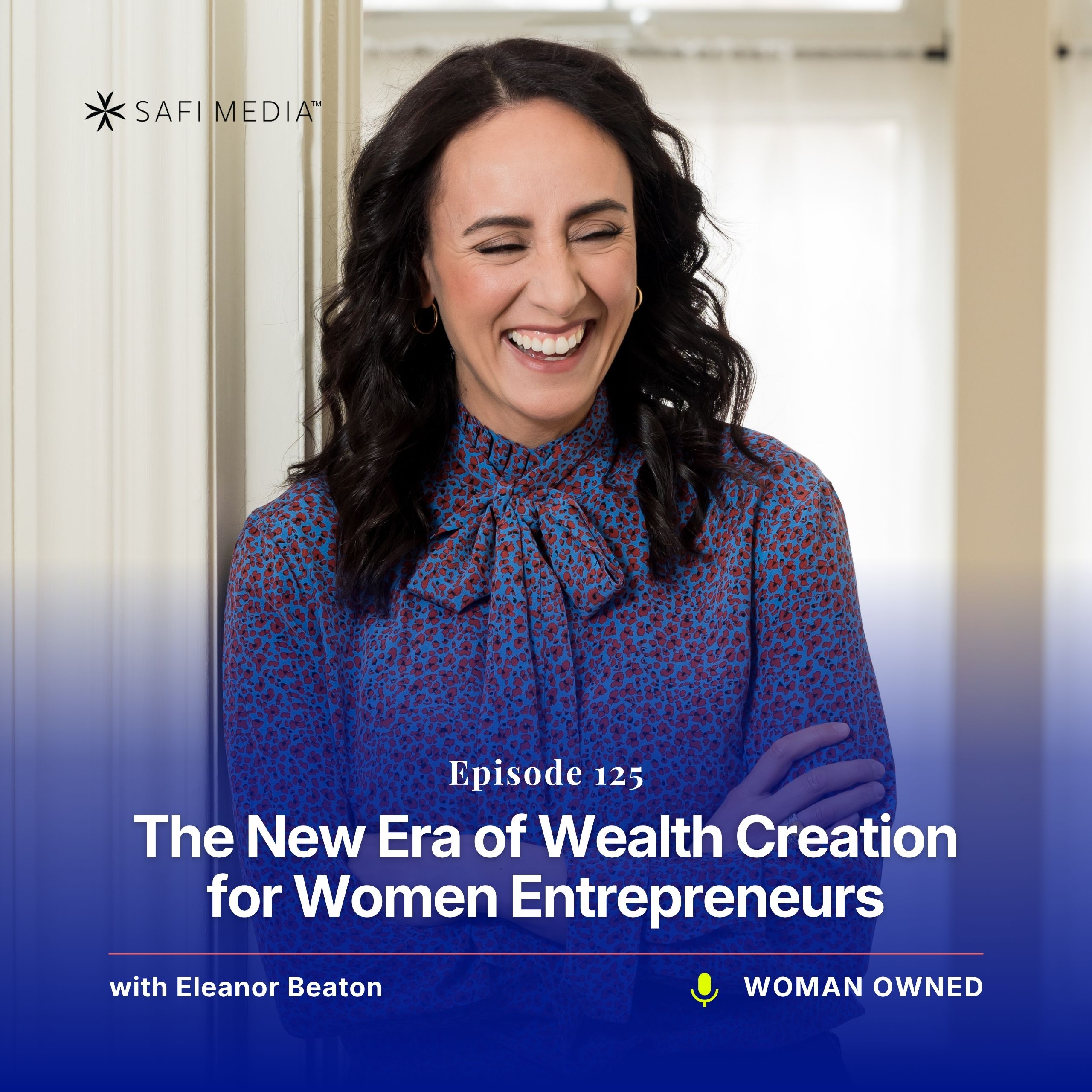
In this episode, Eleanor explores the new era of wealth creation for women entrepreneurs and the growing ambition she is seeing among women to build wealth, influence, and economic power without apology. She introduces a new way of thinking about business ownership: getting paid for the work you do, getting paid for turning that work into repeatable assets, and getting paid again by building a business you can sell.
Listen in this week as Eleanor explains how to think about your business as more than a source of income. Learn why repeatable intellectual property and systems can create value beyond your immediate work, why women entrepreneurs should challenge the assumption that their businesses aren’t sellable, and how building a valuable business asset could create the biggest single payday of your life.
Request a structural read of your business to find out what you can put in place to allow your business to make more income for you here.
Today on Woman Owned:
- Why women entrepreneurs are becoming more unapologetic about their desire for wealth and economic power.
- The three ways a business can pay you: through your work, repeatable assets, and the eventual sale of the business.
- How packaging your knowledge into courses, frameworks, processes, and systems can create assets that generate value beyond your immediate work.
- Why building a sellable business is especially powerful when your working life includes interruptions and competing care responsibilities.
- Why consulting, coaching, product, and service-based businesses may have greater potential as sellable assets than their owners realize.
- How revenue growth, profitability, and open time work together to support a more valuable business.
- Why thinking about enterprise value now can change the decisions you make about the business you’re building today.
Resources Mentioned:
-
- The SAFI Diagnostic is a free, 15-minute structured conversation to pinpoint:
-
- 2 or 3 real problems constraining your growth
-
- How much those problems are costing the business on a monthly and annual basis.
-
- Whether SAFI is the right partner to install the fix.
-
- The SAFI Diagnostic is a free, 15-minute structured conversation to pinpoint:
-
- To receive the Woman Owned newsletter, make sure you sign up here!
-
- Organic Influence: Build a Loyal Following and Sell with Ease by Eleanor Beaton
-
- Check out Eleanor’s YouTube channel!
-
- If you want to be a part of our sales growth case study to see what happens when we partner with you to explode your sales pipeline, contact Eleanor here.
-
- Get my free ebook, How To Know When Cutting Back on 1:1 Client Work Makes Sense here.
-
- Request a structural read of your business here.
FAQ
Podcast Transcript
For the last decade, I have been steeped in the world of women's economic power. How women think about money, how we dream and strive for money, how we generate money, how we generate profit, and how we build the kinds of companies that are enable us to build our economic power. And what I can say is that I have never seen the level of self-awareness, the level of unleashed ambition, the level of possibility-based thinking when it comes to building economic power that I have among women in the last year.
And it's interesting that in the midst of so much geopolitical turmoil, so much technological change, so much uncertainty, I have never seen an era of women's economic power and women's economic power brokering as I have in 2026. And so in today's podcast episode, I'm going to explore one piece, one slice of what I'm seeing, but trust, this is going to be part of a broader conversation that we're having in the world of Safi Ventures as we explore women's economic power.
Welcome to the Woman Owned podcast. I’m Eleanor Beaton and this show is for women who run real businesses and make real decisions. Here, we talk about revenue, leadership, and growth without hype, hustle, or internet nonsense. If you’re building something serious and you want clear thinking you can actually use, you're in the right place.
If you're new to the Woman Owned podcast, hello, welcome. I'm Eleanor Beaton. I'm so glad that you're here with us. I'm the CEO of Safi Ventures, and we are an organization that is really all about helping women entrepreneurs build economic power. And we do that through the installation of sales and scaling systems, and we also do that through ensuring their companies build enterprise value, which means that the company is valuable as an asset itself.
So when I first started Safi years ago, I had a slogan that is really a mantra and is a truth that is backed by evidence, which is that when women earn, we all win. My clients have quoted that. They've used it as forwards in their books. I've had it on our merch. And what was so interesting is this last week, I was in New York attending the WIN Summit. So the WIN Summit is a $60 million prize that is awarded to organizations, nonprofit organizations in particular, that are really advancing innovative solutions to scale women's impact and our economic thriving. So this is looking for scalable, innovative solutions.
And I was honored to be a judge for this award. It's a joint initiative of Pivotal Ventures, which is Melinda French Gates's organization, and also Aspen Digital, which is a division of the Aspen Institute, which is one of the world's premier think tanks. And their slogan was that when women thrive, everybody wins.
And so we really understand, and many of us who have been in this space have been talking about this for years, there is such an incredible body of research that really explores that when women earn, everyone thrives. And I want you to think about that in your own life. When you are thriving, you have such a powerful impact on your family, on your community, on your workplace. And this happens because women, for better or for worse, are the glue that holds our families and our societies and our workplaces together.
And what I am beginning to see, both through, the last quarter, I have been essentially on a listening tour. I have been traveling to different cities. I have been meeting with well, hundreds of women entrepreneurs. And what I am seeing is that women have become totally unapologetic about our desire for wealth and power. That is the really big shift.
And I have my theories about why that's happening. I think we are witnessing the rise yet again of tech giants like the Elon Musks of the world, the Sam Altmans of the world. We are seeing AI, the big AI companies being built and driven by men whose moral compass we question. And we're also seeing the power that comes from that kind of economic and technological prowess. And I think women are like, "Okay, okay, we get it. We want to ensure that we have the influence to be able to create positive change, and we also want that money and power."
I am seeing a very distinct shift. Women no longer feel that they need to apologize for desiring money and power. There are still some threads of it there, but that has really, really changed, and I've seen it really accelerate in the last year. There are still penalties for a woman's ambitious and explicit desire for money and power, but those penalties are much less. And they're less because we understand them, we are aware of them, they exist in the public record, we talk about them. And once you kind of bring something to light and you are aware about it, now you get to choose how to respond to it rather than having it rule you.
The new era of women's economic power begins with our increasingly unapologetic desire for wealth and power. And that era of wealth building is really, really powerful. So I've been having dinners. I've been attending events. I've been talking to women. And what's so interesting is how we are defining wealth. And it really dovetails with our model of growth here in Safi Ventures, which is the Jewel business model. In the Jewel business model, you have 30% or more top-line growth, 30% or more profitability, 30% or more open time.
And these are rules of thumb, but they sort of show the different dynamics of wealth creation, which is growth. Top-line growth allows access, right? Like, as the company gets bigger and as the company grows, it starts to create opportunities for personal growth, create opportunities for network growth and relationship growth. It also creates opportunities. Money is power. That kind of cash flow starts to make more things possible.
But revenue without profit is a recipe for disaster. We also look at profitability, 30% profitability. That's a rule of thumb. Depending on your industry, it can be more or less. And then, of course, the other dynamic is time, and 30% open time for you as a CEO to actually lead and to have space to enjoy the fruits of your labor. And this, of course, is separate from your “free time.”
What we are starting to see now, so the Jewel business model was always a framework or a paradigm for growth. And what we're seeing now in the new era of women's wealth creation is something I want to layer on top of that. And this is a new way. Women are increasingly looking at not only how do I get paid once, but how do I get well paid twice? How do I get well paid thrice?
So, initially, when you start your business, you're often doing the work and getting paid. You're providing the service and getting paid. You're providing the product and getting paid. That's getting paid once. And when we really focused on women's startups and getting more women into entrepreneurship, that's really where we looked at. So it's getting paid once.
Beginning, you know, five, 10 years ago, we at Safi started to see, "Hey, there's a great opportunity for women to create assets that allow them to work once and get paid twice." And so that was, for instance, packaging your knowledge into courses or frameworks or processes. It could be your internal IP, like your internal systems. So getting paid twice was not only doing the work, but turning it into a repeatable process, turning that work into what I would call a level one asset.
So that was getting paid twice. And that's where we were and where we invested a ton of time over the course of the last decade, helping women generate millions in economic power through not only working once and getting paid once, but working once and getting paid twice.
Well, now we're in a new era. And this new era is about getting paid three times. And that is by looking at the business as a whole as an asset that is sellable. And for us as women, our labor is interrupted. It's highly interrupted. We take a lot of time to give birth to babies, to do care for children, to do care for aging parents. For many of us, women in particular, our labor is interrupted.
And that's fine. The challenge is that wealth is built through compounding. And so as we step out of the labor force, we reduce our ability to compound. And because we require flexibility for so much of our life, flexibility often means we take a pay cut. And so not only are we compounding for less time, but we're compounding a smaller total amount.
And so having a business that is a sellable asset is incredibly, incredibly powerful. And so when we look at it this way, we see that increasingly, we have been doing research and have been having conversations with women about selling your business. And here's the thing that I really want you to hear. So there is such a myth out there that women are not building sellable businesses. The businesses that we're building can't be sold. And I'm calling BS on that.
We are about to release our first working paper on enterprise value in women-led businesses. And I'm going to tell you, women are starting businesses that we can sell. Right now, whether you have a consulting business, a product business, a manufacturing business, a coaching business, a service-based business, I want you to not accept the myth that your business isn't sellable.
And I want you to start thinking, "What happens if I'm sitting on a million-dollar asset right here? What happens if the thing that I'm building that people tell me isn't sellable, if I made a few different choices about how I structured it? Or PS, maybe not even at all. Maybe you don't have to do anything differently. But I started to see it not only as something that can pay me today, not only as something that I can create systems that make my life easier and allow me to continue getting paid for work I did last month or last year, but also that I'm actually creating an asset that is going to allow me to have what could be the biggest single payday of my life when I exit that company."
So the new era of wealth creation for women, the new era of wealth creation for women entrepreneurs, the new era of economic power for women, is that women entrepreneurs are going to get paid three times. Number one, for doing the work. Number two, for creating assets that allow that work to become repeatable. And number three, for creating a business that they can sell and having the intention and doing the work to actually sell it.
So much more to come on this, but I wanted to really open your eyes to the shift that we're seeing as someone who's been in this field for well over 10 years now, the shift that we're seeing, the new era of economic power for women, and opening your mind to the possibility of what happens when you consider that what you have built is not only something that's helping you generate income today, but something that could create generational wealth for you over time.
All right, thanks so much for being here, and we will see you next week.
If you’d like a seasoned POV on how this applies to your business, you can learn about my private diagnostic at SafiMedia.co/POV. Otherwise, thanks for listening and I’ll see you next time.