If you want to create exceptional income and profit in your business and also create exceptional freedom and ease in your company and the way you generate that income, you need to stop focusing on selling more and start focusing instead on how you are creating true, long-lasting value in your business and in the work that you do. In today's episode, I'm going to walk you through the three stages of the value flywheel to help you do just that.
Welcome to the Woman Owned podcast. I’m Eleanor Beaton and this show is for women who run real businesses and make real decisions. Here, we talk about revenue, leadership, and growth without hype, hustle, or internet nonsense. If you’re building something serious and you want clear thinking you can actually use, you're in the right place.
Hello everyone. Welcome back to Woman Owned. I am so excited that you are here because of a very powerful piece of work and piece of IP that I'm going to share with you today. And this is about the value flywheel and how you create a business that generates momentum. It generates profitable revenue and it generates tremendous impact for you and for your stakeholders. And that could mean your customers, it could mean your audience, it could mean your team, it could be your shareholders. So, let's dive into it. And before we get into it, I want to start with a story.
So there's this tremendous story from the Gold Rush times where there was a prospector who heads out to the heart of the Gold Rush in California, and he identifies a vein of gold. He realizes he's going to have to make some investments in machinery to get it, and so he goes back home. He raises a big sum of money from his family and from his neighbors and from his friends. And then he heads back out to Gold Rush territory, buys the equipment, and in one season, generates enough profit to not only pay back his investors, to give them a return, but pay off his equipment.
And he just feels really great. So he wants to double down. He goes back for the next season and continues mining. But this time he finds that his results are not as good. He seems to have come to the end of the gold vein, and he gives up. He sells his equipment for pennies on the dollar and heads home with his tail between his legs. He made some money, but it wasn't what he hoped for.
Now, the person that he sold his equipment to was a very wily individual. They took another look at this vein of gold and they did some of their own digging. And they decided that they were, rather than go and find another vein of gold, they were going to stick to this mining site. And they started mining. And lo and behold, after about mining just about three feet further into the cave, they struck a massive vein of gold.
This idea of stopping three feet from gold was of course memorialized in a book from the Napoleon Hill Institute, and it has been an often shared story about the human condition of not recognizing the value that is right in front of us. And as an advisor to exceptional women entrepreneurs, I can tell you that I have oft seen this story perpetuated by entrepreneurs who don't see the value that they are sitting on. And the reality is that if this has happened to you, it's actually part of the human condition.
There is an amazing Joni Mitchell song. It's the one where she talks about we paved paradise and put up a parking lot. I think it's called Taxi Cab, Yellow Taxi Cab, Big Yellow Cab, or something like that. And in it, she says, "Don't it always seem to go, we don't know what it's got 'til it's gone." And so a part of the human condition is that it is very difficult for a human being to recognize the value that is in front of them. And this is why surrounding yourself with strong judgment and excellent advisors and a tremendous peer group can be really important because their perception allows them to see this value sometimes better than you can. And that's what today's episode is all about. It's about something that I've developed called the Value Flywheel.
So, what I am actually exceptionally good at, and the reason that my clients invest to work with us again and again and again, is because of my, I'm going to claim it, extraordinary ability to see where value is trapped inside a woman-led business. First of all, to see it, and then to name it clearly so she can act upon it. When you are able to receive this very clear diagnosis about where value is currently trapped inside your current business model, it produces stronger decisions and stronger business results for success-minded founders, and it enables you to save money, save time, and work on the correct levers that are going to produce the most results for you. So it is a very powerful skill set for others and a very lucrative and profitable skill set for me to have and to deploy across advisory and to tools like this podcast.
And so in last week's episode, I gave you an example of how I led a group of 65 women founders through an exercise like this, which enabled them to see $79 million in revenue that was trapped in their current business models. And I have done this again and again. It's one of the core things that I do in my keynotes. It's one of the core things that I do in my individual work with clients and through the people that we work with at SAFI.
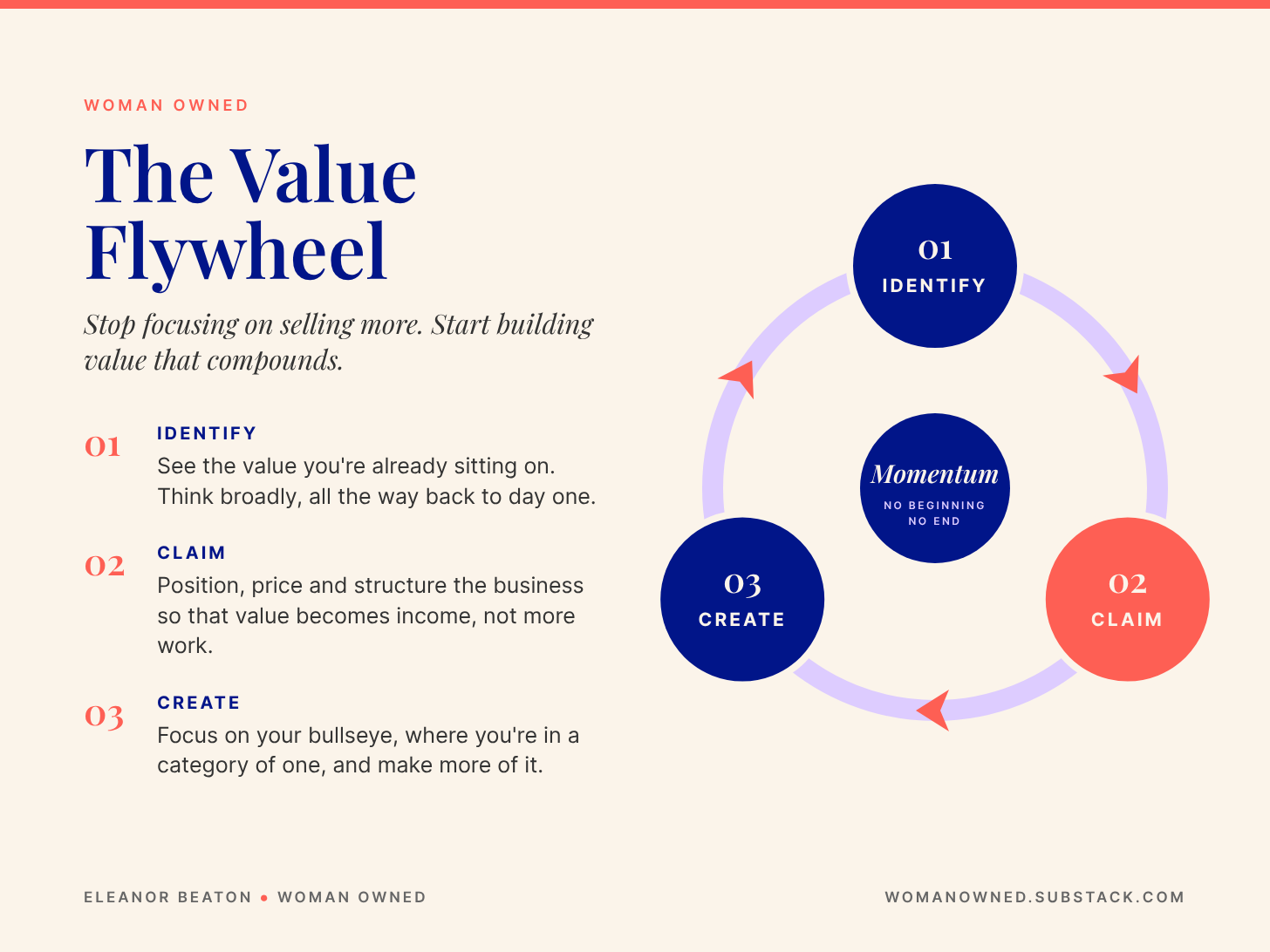
So I wanted to share a little bit about how I do that. And so I wanted to kind of talk through the value flywheel. So the value flywheel has three components. And when you start focusing not just on selling more or making more money, but on generating, creating, realizing, and sharing tremendous value, you start to experience extraordinary results and extraordinary freedom, right? That's the key. You are creating a model of growth that it's like a flywheel, you know, it just creates tremendous momentum.
And that's the thing. What I always found myself was that when I focused on just selling, selling more, it's incredible skill set, right, but just selling more, it might create a short-term spike. When I have focused on building value, it's kind of like the difference between eating a pack of Skittles, which is just go sell something, and eating a really well-created, balanced, nutritious, tasty meal. One is very substantive and creates positive results. One creates a short-term high, a short-term spike, but often a bit of a hangover afterward.
The value flywheel has three components. First, you create value, then you identify value, and third, you claim value. And I actually shouldn't say first you create because it's a flywheel, so it's, it's kind of like there's no beginning and there's no end. You're generating a flywheel of momentum. So, we're actually going to start not with creating value, which is why I shouldn't have said that's first. We're going to start with identifying value. So the first step in the value creation flywheel is to identify the value that you are currently sitting on. And when I guide people through this exercise, they are often astounded by the value that they are able to easily identify that they've already created. And I want to tell you a story about this.
In the 1980s, there was a farmer from Michigan, and he acquired a Michigan farm in 1988. This is when I was about 10 years old. He acquires this farm and he acquired with it like this huge, kind of interesting-looking rock. And he used it as a doorstop. Okay? So this massive rock, he uses it as a doorstop. And it's just there. People kick the dust off their boots on it. It gets covered in snow from time to time. It's literally just a doorstop. And then one day someone says to him, "You know, it's interesting. It could be a meteorite."
So in 2018, 30 years after buying the farm, he takes it to a geologist at the Central Michigan University. This geologist confirms this is a meteorite and it's worth about $100,000. Right? He already owned the treasure. What changed was his understanding of its value.
And so when we think about identifying value, there's lots of different ways to do this. But for instance, have you ever thought about, we always think about what's your annual revenue this year? I want you to sit back and think about how much income and revenue have you generated since you first started your business? How much revenue have you generated since you first started your business? Think about how much money have you circulated back into the economy through your payroll and through your paying of vendors. Think about that.
I know this one might be painful to some of you, but how much have you circulated to your country, to your countrymen and countrywomen and country people through the investment of your tax dollars? What kind of collective impact have you generated for your clients and their families? What's the value that you've created through your mentorship or guidance or through the value of the work that you do?
So really thinking about your value as a whole and the value that you have created. That's about identifying your value. Now, when I am working in a focused way with a founder, we will often use this to identify their unique value. So really understanding, and this comes down to kind of what is known as your hedgehog. What are you uniquely great at? What do you do exceptionally well that when you focus on this, you are in a category of one, right? And so this is a big part of identifying from a business perspective of doing this. But I think you need to think very broadly about value, because what I always found was when I didn't flash out broadly enough, I was only thinking about a small fraction of the value that I had actually created. And when I really allowed myself to be much more expansive in terms of how I thought about it, it was much more rewarding.
Okay. The next part is then claiming that value. So claiming value, this is where, so first you're identifying it to understand it. And then when you claim value, this is where you start to be able to create a model that allows you to do your greatest work and have your maximum impact without overworking, over-hustling, over-delivering. Because it's almost impossible to not over-deliver and not hustle. The conditioning is so deep that it's almost impossible not to do those things if you aren't taking stock of the value that you create to begin with.
And so this is where we do things like really look at your positioning in the marketplace. Are you well positioned to capture the appropriate market? Are you in first class or are you in coach? One isn't necessarily better than the other. It's going to depend on your positioning and where you want your business positioned. Like Walmart is coach, and they're not hurting. Okay? So I want to be very clear, this is not about being elitist.
We look at your positioning. Then we really take a look at your offer. And this is a huge one. And I've really been looking at this myself. I look at this on a regular basis. Is your offer an accurate reflection? Is it well designed to create not only the financial results that you want, but the life that you want? You know? And so when we look at your offer, are you pricing it well? Are you making it incredibly valuable? Are you being very focused in what you do? Are you doing things that exhaust you as part of this offer? Like really take a look at the offer. And then we also want to take a look at two core things here. One is your commercial architecture. And commercial architecture, it involves things like offering, positioning, pricing, and also your sales process. And then we also look at profit architecture. And that's where we're also looking at things like how founder dependent is your company, what is your delivery process like. So these two things, usually commercial architecture and founder independence, I often think about this as profit architecture. These two things allow you to realize maximum value.
And then you go back to creating value. And we create value when we focus, you know, like a bullseye on that specific place where we are uniquely good at. We create enormous value around. And when we focus like an absolute ninja on that place, on that bullseye, this is value creation at its maximum potential. And this is also this level of focus is how you start to create exceptional financial results with minimal energetic drain, right? This is the value creation flywheel.
So I hope you found this useful. And my goal for you, my invitation for you, is to reflect on that first step I talked about. What is the value that you have created broadly speaking? And are you efficiently turning this value into income? That's the invitation here.
Now, if you would like to kind of have this in essay format, please go to the Woman Owned Substack, womanowned.substack.com. And you can not only see this in video format, but you can also read the sort of essay that accompanies it. And then if you upgrade to Operator, that's $197 a year, you will get a weekly or roughly weekly paid upgrade essay, as well as live masterclasses that happen bimonthly that really lock in these learning. So you can come and learn with me. And this week, the paid essay is actually a workbook that allows you to identify value more fully in your business. So we really focus on that value identification part.
All right, thank you so much for being here. Again, if you appreciated this podcast, make sure you hit subscribe. We would very much appreciate that. Leave us a review. And if you want more, go to womanowned.substack.com. Thanks so much for being here. Talk soon.
If you’d like a seasoned POV on how this applies to your business, you can learn about my private diagnostic at SafiMedia.co/POV. Otherwise, thanks for listening and I’ll see you next time.